Rescheduling Isn’t Liberation: Schedule III Ignores 30K American Cannabis Prisoners & Industry Growth
As a Toronto-born Canadian raised alongside American family and a die-hard U.S. ally, let me call it like I see it: the cannabis shift from Schedule I to III is progress on paper, but way too timid to end the real prohibition pain. On December 18, 2025, President Trump signed an Executive Order directing the U.S. Attorney General to expedite the rescheduling of cannabis from Schedule I to Schedule III under the Controlled Substances Act (the CSA) [3]. U.S. President Donald Trump's recent Cannabis’ rescheduling move from Schedule I to Schedule III is definitely a step forward, but its simply a cosmetic policy makeover on an old decrepit prohibitionist body. This rescheduling is a band-aid on prohibition's rotting corpse, timed perfectly for midterm optics! Moving cannabis from Schedule I to a Schedule III helps politicians pose as reformers, while millions of regular American cannabis consumers and cannabis prisoners remain stuck in a sick, immoral and outdated justice system that still treats cannabis like a dangerous chemical drug. Descheduling foot-dragging harms patients, cannabis businesses, and communities. Most critically, Schedule III leaves an estimated 30,000–40,000 American Cannabis Prisoners behind, who are incarcerated for primarily non-violent cannabis offenses like possession or low-level distribution according to 2025 data from groups like the Last Prisoner Project [1] and The Sentencing Project [2], spanning state prisons, federal facilities, jails, and parole violations.
The Incarceration Pipeline: Still Clogged
Federal level — Fewer than 10,000 (some estimates around 3,000–10,000 prior to recent commutations). In January 2025, President Biden commuted sentences for 2,500 individuals incarcerated for non-violent drug offenses, including many cannabis cases, reducing the federal number further.
State level — The bulk of cases, often in states where cannabis remains illegal or partially restricted.
Pure possession only — A much smaller subset; historical data (e.g., from older Bureau of Justice Statistics surveys) showed less than 1–2% of state prisoners incarcerated solely for marijuana possession, and virtually none federally for simple possession alone in recent years.
Broader drug offenses — About 366,000 Americans are incarcerated for any drug offenses (per Prison Policy Initiative's 2025 Whole Pie report) [6], but cannabis-specific estimates are lower due to other drugs like opioids and meth.
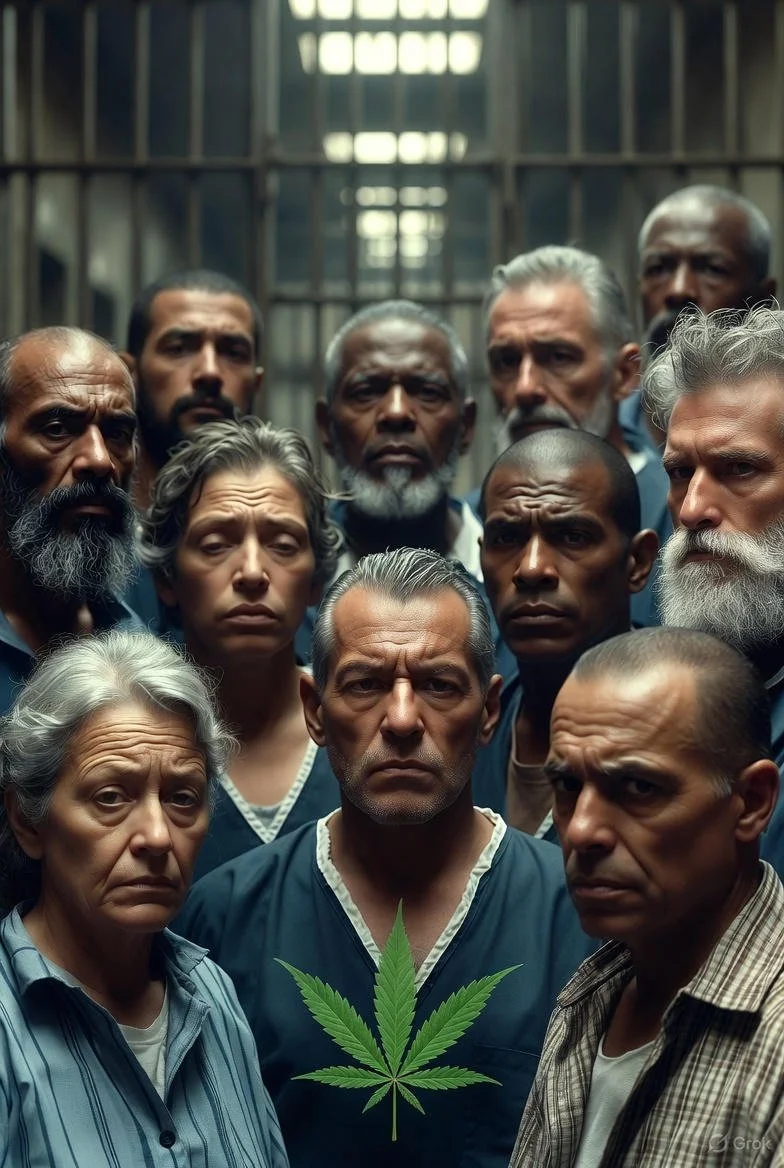
Non-Violent American Cannabis Prisoners–They’re just like you, but their fate was much different.
Cannabis Safer Than Booze? Peer-Reviewed Science Says HELL YES
Cannabis kills way fewer people than federally legal alcohol. A 2015 NIH study [4] clocked marijuana's mortality risk at 114x lower, with no fatal ODs, ever. The Lancet's [5] 2007 expert panel ranked alcohol tops for harm, cannabis near-bottom. Meta-analyses confirm: cannabis-linked motor vehicle crash risk is milder (OR 1.5–2.5) than alcohol's wrecking ball, with chronic users even buffering booze's edge. Brain health? Alcohol shreds it more. Yet we regulate weed like heroin while big Alcohol lobbies remain powerful and influential. Cognitive dissonance much?
Realize the Cannabis Sector’s Latent Value w/Descheduling
The cannabis sector is still reshaping economies: North America commands the largest share, with the U.S. at the forefront of medical, recreational, and nutraceutical demand, while the global cannabis market valued at $72.83 billion in 2025 [7] charts a trajectory to $125.76 billion by 2030, growing at an 11.5% CAGR driven by cannabis wellness products, edibles, and various hemp solutions [7]. This expansion reflects a profound consumer shift toward plant-based solutions for health and wellness, underscoring a total addressable market ripe for capital. Schedule III offers incremental relief but perpetuates banking constraints and interstate barriers; full legalization would liberate seamless scaling, accelerate VC and Private Equity investment, and realize the cannabis sector's latent value.
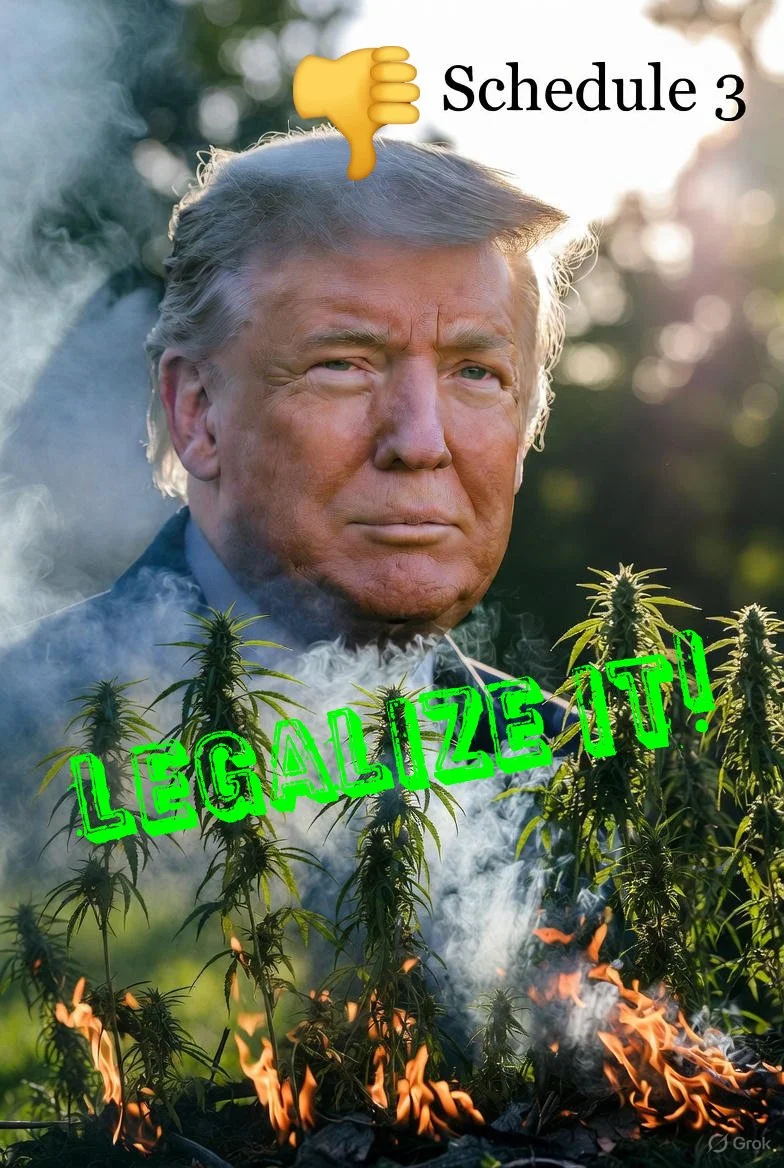
The global cannabis market is valued at $72.83 billion in 2025. Go fully legal, America, and you unleash billions in USD revenue. America could swap street deals and incarceration for sunny storefronts and IPO’s, ending the hypocrisy, and healing communities.
Full Legalization: The Solution
Full legalization is America's overdue knockout punch to cannabis prisoner injustice and a contrained cannabis industry. Schedule III is a half assed deal where the legal cannabis industry’s growth is still suppressed and 30,000–40,000 American citizens will continue to waste away in state pens, county jails, and parole purgatory. Descheduling is the ultimate fix because anything less, like Trump's Schedule III rescheduling, keeps the cage doors slammed shut while stifling a booming cannabis industry … think Billions ‘with a B’ in untaxed revenue, stalled jobs, and shuttered dispensaries. All so Big Alcohol can keep peddling its 140,000 annual body count (CDC numbers) [8] with full federal blessings and lobbyist swagger. Weed? Zero overdose deaths, way safer crash stats, and brain-friendly compared to booze's wrecking ball, as peer-reviewed studies hammer home time and again. Mr. Trump, go fully legal with cannabis and you unleash billions in USD revenue to bankroll expungements, rehab the wrongly caged, accelerate legitimate cannabis businesses, and swap street deals for sunny storefronts and IPO’s, ending the hypocrisy, and healing communities, and proving cannabis policy can finally play fair in America.
- Steven Grabenheimer
SOURCES
[1] Last Prisoner Project https://www.lastprisonerproject.org/
[2] Sentencing Project https://www.sentencingproject.org/
[3] The White House https://www.whitehouse.gov/presidential-actions/2025/12/increasing-medical-marijuana-and-cannabidiol-research/
[4] NIH https://pmc.ncbi.nlm.nih.gov/articles/PMC2722956/
[5] The Lancet https://www.thelancet.com/journals/lancet/article/PIIS0140-6736(07)60464-4/abstract#:~:text=We%20developed%20and%20explored%20the,and%20future%20drugs%20of%20abuse.
[6] Prison Policy Initiative https://www.prisonpolicy.org/reports/pie2025.html
[7] MarketsAndMarkets https://www.marketsandmarkets.com/PressReleases/cannabis.asp
[8] CDC https://www.cdc.gov/mmwr/volumes/73/wr/mm7308a1.htm